What Is Pollo al Chilindrón?
If you have ever typed best pollo al chilindron near me into your phone while you were hungry, you already know the feeling. You want a warm plate of chicken in a rich pepper and tomato sauce, not a random stew with a Spanish name attached to it. That is the whole point of this guide: to help you find the real dish, close to home, and to know it when you see it on a menu.
Pollo al chilindrón is a classic dish from Spain. It comes from the regions of Aragon and Navarre, in the north-east of Spain, and it is also well loved in La Rioja and the Basque Country. The name gives you a clue. In Spanish cooking, “chilindrón” means a sauce made with peppers, tomatoes, onion, garlic, and ham. Some people say the word comes from “chilindrina,” a card game, because the colourful peppers in the sauce look like the bright cards used in the game, but that link is a story, not a proven fact. What is certain is the flavour: sweet peppers cooked slowly with onion, tomato, and cured ham until the sauce turns deep, glossy, and slightly sweet.
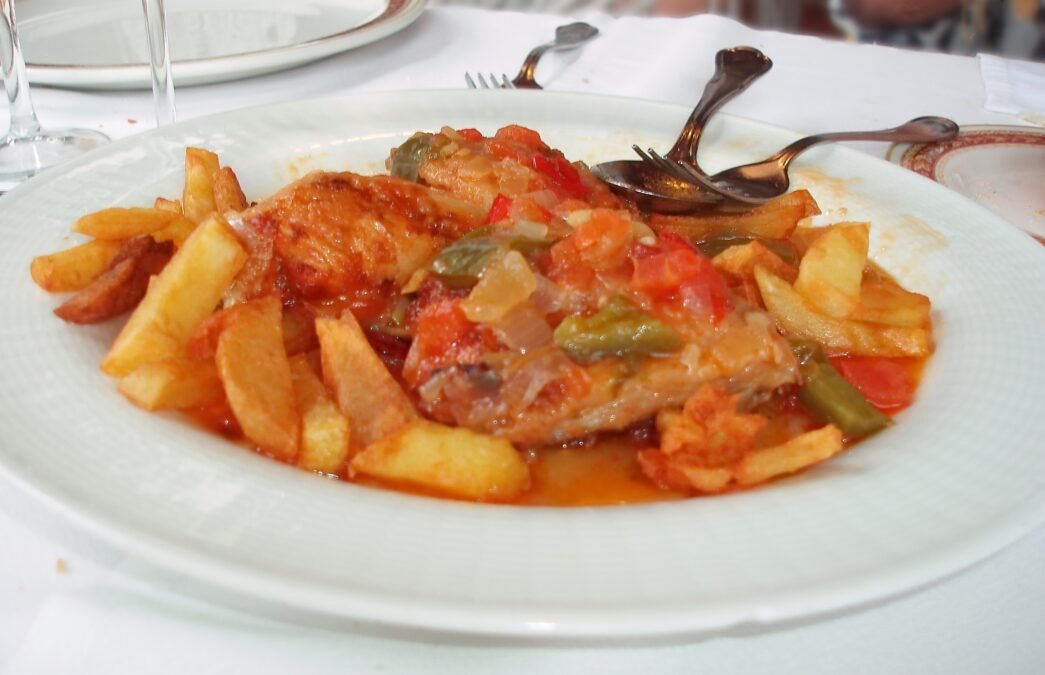
The chicken is usually bone-in, often thighs and drumsticks with the skin on. It is browned first, then simmered in the sauce until it is tender and the sauce has gathered around it. The result is not dry and not drowned. The chicken should fall from the bone with a nudge, and the sauce should be thick enough to coat a spoon, not thin like soup.
Because the dish is simple, small choices matter. The peppers should be sweet, the tomato should be ripe, and the ham should be a cured Spanish ham such as jamón serrano or a good cured country ham. The dish does not need cream, cheese, or a long list of exotic spices. When you find it done well, you will taste the peppers first, then the sweet tomato, then a gentle warmth from good paprika and garlic. That is why a search for the best pollo al chilindron near me should end at a place that gets these small choices right.
The two peppers that make it real
Most of the flavour in pollo al chilindrón comes from peppers. A good cook will use a mix, and the mix changes slightly from town to town, but the idea stays the same: fresh sweet peppers for body and colour, and a softer dried pepper flavour for depth.
- Fresh red peppers: Sweet red bell peppers, cut into strips, are the main pepper in the dish. Green peppers often join them for colour and a light bitter edge.
- Dried peppers or pimentón: In Aragon and Navarre, cooks often use dried red peppers, or a good sweet or smoked paprika (pimentón), to give the sauce a deeper red colour and a warm, rounded background note.
- What to look for: A sauce that is brick-red to deep orange, not pale beige and not dark brown. Bright, uneven pieces of pepper also tell you the cooks used fresh peppers.
- What to avoid: A sauce that tastes mainly of chilli heat. Pollo al chilindrón is not a hot chilli dish. A little warmth is fine, but a mouth-burning sauce usually means the balance is wrong.
Pollo al chilindrón vs. similar chicken dishes
You may see other chicken dishes on the same menu that sound similar. Here are the main differences, in simple terms, so you can pick the right one next time.
| Dish | Sauce and flavour | Key difference |
|---|---|---|
| Pollo al chilindrón | Peppers, tomato, onion, garlic, cured ham | This dish: a thick, sweet pepper sauce with ham |
| Pollo en salsa | Flavoured stock, onion, wine, herbs | A thinner wine sauce, usually without a strong pepper flavour |
| Chicken in mushroom sauce | Mushrooms, cream, garlic | A pale cream sauce, not a red pepper sauce |
| Pollo al ajillo | Garlic, oil, wine | Chicken cooked mostly in garlic and olive oil, with little sauce |
| Pollo a la pepitoria | Almonds, egg yolk, saffron | A creamy saffron sauce from a much older Spanish recipe |
That table is a quick cheat sheet. If the dish in front of you looks like a pale cream sauce, it is probably not chilindrón. If it is a deep red sauce with visible pepper strips and a small amount of ham, you are on the right track.
A quick history you can enjoy in two minutes
Pollo al chilindrón has a long history in Spanish home cooking. People in Aragon and Navarre have cooked chilindrón sauce with lamb, chicken, and rabbit for generations, and it is one of those dishes that every family cooks a little differently. Some families use more onion, some use more pepper, and some add a small amount of white wine. All of those small choices are normal. That long history is part of why the best pollo al chilindron near me is usually found in a family-run Spanish restaurant rather than a chain.
The dish travelled from home kitchens into tapas bars and family restaurants, and from there, with Spanish and Latin American restaurants around the world, it reached diners far from northern Spain. Today, you can find it across the United States in Spanish restaurants, in Latin American places that also serve Spanish classics, and on some seasonal menus in Basque and Catalan restaurants.
One useful note: the Spanish spelling uses an accent: chilindrón. You will often see it without the accent on English menus, and that is fine. Searching with or without the accent will often bring up the same places, so try both spellings when you search.
How to Find the Best Pollo al Chilindron Near Me
The word “best” depends on what you like, but there are some reliable ways to find a good version close to you. The trick is to search wider than one phrase, to read the menu carefully, and to look at what real diners and cooks actually say, not just what an advert says.
Start with a search, but try a few versions of it. “Best pollo al chilindron near me” is a good start. Then try “pollo al chilindrón [your town]”, “Spanish restaurant near me”, “Aragonese restaurant near me”, and “Basque restaurant near me”. You can also try “chilindrón sauce” and “Spanish chicken in pepper sauce”. Each version brings up slightly different places. Some restaurants call it simply “pollo” and hide the word chilindrón in the description. A menu search can find those.
After that, check the map result and the menu, not just the star rating. A restaurant with a 4.6 rating and one review that says “the chilindrón was rich and the chicken was tender” tells you much more than a 4.9 rating for a place that serves a different menu entirely.
Then, read the dish description. A good sign is a line that names the key ingredients: red peppers, onion, tomato, garlic, and ham. A weak sign is a vague line such as “chicken in a Spanish sauce” with no detail. Vague wording is not proof that the dish is poor, but it is a sign that the restaurant itself may not see this dish as a speciality.
If you can, call ahead and ask a simple question: “Do you serve pollo al chilindrón, and is it on the menu today?” Many Spanish restaurants cook it as a weekend special, a daily special, or a tapas dish instead of a main course. It is not unusual to find that it is not served every day. A quick call saves a wasted trip.
Here is a quick checklist to use before you leave the house:
- Search wider: try the dish with your town name, try “Spanish restaurant”, and try the Spanish name without the accent.
- Read the menu, not just the rating: look for the ingredients named on the dish line or in the description.
- Read the newest reviews first: one recent, detailed review about this dish is worth more than a long string of old, general praise.
- Look at the photos: diners’ photos (not just the restaurant’s own perfect picture) show the real plate, sauce, and size of the portion.
- Call if it is a special: if the menu says “weekend special” or “ask your server”, call first.
- Check the kitchen’s focus: if a restaurant cooks Spanish and Basque food day after day, it is much more likely to cook chilindrón well than a place that offers it as one of a hundred global dishes.
Best places by city
Different cities have different Spanish food scenes, and the best pollo al chilindron near me depends on where you live. The list below is not a directory of restaurants, and it does not promise that a specific restaurant in your town serves this exact dish. It simply shows how to think about where to look in each kind of city, so you can use the search steps above with more confidence.
| City or area | Why the search often works there | What to try first |
|---|---|---|
| New York City | Large Spanish food scene in Manhattan and Queens | Search “pollo al chilindrón NYC” and “Spanish restaurant Queens” |
| Los Angeles | Many Spanish and Latin restaurants, plus Basque spots | Search “pollo al chilindrón Los Angeles” and “Basque restaurant Los Angeles” |
| Miami | Strong Spanish and Cuban food scene | Search “pollo al chilindrón Miami” and “Spanish restaurant Miami” |
| Chicago | Long-running Spanish restaurants and tapas bars | Search “pollo al chilindrón Chicago” and “Spanish tapas Chicago” |
| Houston | Large Spanish and Latin food market | Search “pollo al chilindrón Houston” and “Spanish restaurant Houston” |
| San Francisco Bay Area | Basque restaurants, Spanish places, and food markets | Search “pollo al chilindrón Bay Area” and “Basque restaurant San Francisco” |
| Smaller towns | Fewer Spanish places, more home cooking | Try an online recipe, or ask a local Spanish community or grocer if they know a restaurant that serves it |
This is a starting point, not a guarantee of any single restaurant. Always check the current menu and call before you travel, because a dish can leave a menu without a notice online.
What Makes a Good Pollo al Chilindrón (How to Judge Quality)
You do not need to be a chef to judge pollo al chilindrón fairly. You only need to know what to look for when the plate arrives, and you can do that in about thirty seconds. If you are searching for the best pollo al chilindron near me, these are the same signs to look for on the plate in front of you.
First, look for bone-in chicken. The best versions use thighs and drumsticks, with the skin on, cooked long enough that the meat pulls cleanly from the bone. If the chicken is dry, stringy, or comes off the plate in tidy boneless cubes, ask where the sauce came from. Boneless chicken can be cooked well, but it is easier to overcook and harder to keep juicy. A restaurant that uses bone-in chicken and simmers it slowly has usually thought about the dish.
Then, look at the sauce. It should be thick and glossy, and it should cling to the chicken. A spoon dragged through it should leave a path that fills in slowly, like a good tomato sauce. If it is watery, pale, or greasy on top, the sauce was probably rushed, thinned with stock, or made with too little pepper and tomato.
Next, taste the balance. In a good dish, the peppers are sweet, the tomato adds a mild sour note, and the ham adds a salty, smoky depth. You should be able to taste each of those elements at the same time. If one flavour dominates — only heat, only sweetness, or only salt — the balance is off. The fragrance should be warm and peppery, and you should be able to smell a little garlic and a little smoke from the paprika.
Then, check the rice or the bread. This dish is often served with white rice, a good loaf of crusty bread, or roasted potatoes. The point of the side dish is to scoop up sauce, so the bread should be crusty enough to keep its shape in the sauce, and the rice should not be mushy.
You can also ask the staff about how it is made. A good restaurant’s staff will be happy to say whether their dish uses fresh peppers, jamón serrano, or a house tomato sauce. A quick, friendly answer is a good sign. A confused or blank answer does not mean the food is bad, but it may mean the dish is not one of the restaurant’s own specialities.
The quick quality test
Here are five clear signs to look for, in one place. If you see most of them, you have probably found a good cook.
- Tender bone-in chicken: Falls from the bone, is moist, and is not dry or stringy.
- Deep red sauce: Brick-red or warm orange, thick enough to coat the chicken.
- Visible pepper strips: Pieces of red and green pepper that you can see and bite into, not a smooth plain sauce.
- Balanced flavour: Sweet pepper, tomato, a little heat, and ham. No single flavour that drowns the others.
- Good sides: Rice or bread that lifts the sauce, and a portion that feels right for the price.
Booking, Ordering, and Enjoying It
When you have found a promising place, you can make the visit easy with a few simple steps. A little planning also helps when you are trying the best pollo al chilindron near me for the first time.
Start by calling ahead or booking online if you can. Many Spanish restaurants are small or busy at the weekend, and a good table at 7 p.m. on a Saturday is harder to get than a Tuesday lunch. Booking also lets you ask whether the dish is served that day.
When you book, mention the dish in plain language. You can say: “We’re hoping to try your pollo al chilindrón. Is it the chicken in pepper and tomato sauce, and is it on the menu tonight?” That question is simple enough to answer, and it puts the restaurant on notice that you care about this dish.
On the night, ask what comes with it. Sauce is the point of the dish, so ask for rice or bread, and ask for the price before you order if it is not written on the menu. If the price is higher than a normal chicken dish, that is not a problem by itself: a dish with good cured ham and slow cooking should cost more than a fast plate, but the price should match the portion and skill.
Finally, check the options if you have a diet need. Ask about gluten and dairy, ask whether the dish uses pork, and ask for a plain version if you are trying to avoid too much salt. Most simple Spanish dishes do not use cream, but it is worth asking whether it contains flour to thicken the sauce.
For eating-in, ordering takeout, or delivery, here are a few small ideas to help you enjoy it:
- Eat in when you can: The chicken and sauce taste their best straight from the pan, when the peppers are still warm and the skin is still soft but not soggy.
- Order takeout carefully: If you pick it up, keep the sauce separate if you can, so the bread does not go soft in the bag.
- Save the extra sauce: Extra sauce is good on rice the next day, or on top of a simple omelette. It is one of those sauces that tastes even better the following day.
- Try a simple side: A green salad with a light dressing is a good fresh balance for a rich sauce.
- Choose a simple drink: A light Spanish red, a dry white, or a glass of sparkling water will all work with the peppers.
FAQs About the Best Pollo al Chilindrón Near Me
What is pollo al chilindrón?
Pollo al chilindrón (often written without the accent as “pollo al chilindron”) is a traditional Spanish chicken dish in a sauce of sweet red peppers, tomato, onion, garlic and cured ham. The sauce is thick and slightly smoky, and the chicken is cooked in it until tender. It comes from the north-east of Spain — most strongly from Aragón and Navarre — and is a popular family dish across Spanish cooking, not just a one-region recipe. The dish is a main dish, most often served with rice or good bread.
What does pollo al chilindrón taste like?
It tastes of sweet peppers, ripe tomato, garlic, and a little salt from cured ham. The flavour is rich and rounded, not overly hot or too sweet. If you choose a restaurant that respects this balance, the dish can be both rich and refreshing at the same time. It’s less sweet than Korean chicken sauces, less tangy than Mexican mole, and less creamy than butter chicken’s sauce — its main profile is peppers and tomato, not cream or chilli.
Where can I find pollo al chilindrón near me?
Try a search for “pollo al chilindrón” with your city name, plus “Spanish restaurant near me” and “Basque restaurant near me”. If your first search returns nothing, try “Spanish restaurant” (not the dish name) and “Basque restaurant” (not the dish name). Browse the menu for this dish, read recent reviews that mention it, and call before travelling if you expect it to be on that day’s menu. Also try OpenTable, Yelp, TripAdvisor and Google Maps — check their menu pages and latest reviews first. Searching for the best pollo al chilindron near me, with your town name added, usually gives the most useful results.
Is pollo al chilindrón spicy?
No, not really. It’s mildly flavoured, not a spicy dish. Some versions may include a pinch of hot paprika or a small piece of chilli, but most good versions keep the warmth low. The point is the sweetness of the peppers, not heat. If a restaurant warns you that this dish is hot, ask what kind of “hot” they mean — and you might be comparing a different dish for heat.
How much does it cost?
The price varies by location and restaurant type. In a casual Spanish restaurant in a US city, a main course of pollo al chilindrón typically costs around $16 to $28. In a higher-end or big-city restaurant, the same dish may cost $28 to $40. The cost varies by the type of chicken, the ham used, the setting, and the side dish. Those figures are only typical examples. Always check the current menu or call the restaurant for the exact price for a given time and place.
What is a good alternative if I can’t find it near me?
If there’s no Spanish restaurant nearby, try a simple version at home (see the recipe below). Or, if you can find a different Spanish chicken dish, try “pollo en salsa” (chicken in a wine sauce) or “pollo al ajillo” (garlic chicken), as a near substitute. Or, if you’d rather stay closer to the original, try a chicken dish with peppers and tomato in the sauce from a Latin or Italian restaurant, as a close but distinct dish.
What should I order with it?
White rice is the classic side, and crusty bread is useful for soaking up the sauce. A simple green salad with olive oil and a light vinegar dressing is a good way to keep the meal fresh and balanced. If you want potatoes, try roasted potatoes or patatas bravas if they are served separately.
A Simple Home Recipe If You Can’t Find One Nearby
If your search for the best pollo al chilindron near me comes up empty, the dish is also simple to make at home. You do not need to be a professional cook. Below is a simple approach that keeps the dish true to the original. If your search for the best pollo al chilindron near me comes up empty, this home version is a good fallback.
- Use bone-in chicken thighs and drumsticks, with the skin on.
- Brown the chicken in olive oil until the skin is golden. Set it aside.
- In the same pan, cook sliced onion, sliced sweet red peppers, and sliced green peppers until they are soft.
- Add minced garlic, chopped cured ham or serrano ham, and a little sweet pimentón. Cook for a minute.
- Add chopped ripe tomatoes and a splash of white wine. Cook for a few minutes to make the sauce.
- Return the chicken to the pan. Cover and simmer over a low heat for about 35 to 40 minutes, until the chicken is tender and the sauce has thickened.
- Season with salt and pepper at the end, and taste the sauce before you serve it. Add a little more tomato if it is too rich, or a little more pepper if it is too sharp.
- Serve with white rice or bread, so that the sauce gets used up, not wasted.
That is the recipe. The main things to remember are to brown the chicken, to use fresh peppers, and to let the sauce cook long enough to thicken.
Final Thoughts: A Dish Worth Seeking Out
If you have ever loved a meal because it felt warm and generous, you already know why best pollo al chilindron near me is a search worth making. It is not just a piece of chicken. It is a sauce with peppers, tomato, and ham, cooked slowly and served simply. It is also a taste of home cooking from northern Spain: a family dish that puts peppers first and lets the chicken absorb the flavours as it simmers.
Once you find a restaurant that cooks it well, you’ll know the difference. The chicken will pull cleanly from the bone. The sauce will coat a spoon. And the flavour will be deep, sweet, and satisfying. If you cannot find one nearby, try the simple recipe at home and see how it feels to make that sauce for yourself.
So, the next time you type best pollo al chilindron near me into your phone, remember to look for a real chilindrón: a thick, red sauce with visible pepper, a bone-in piece of chicken, and a friendly cook who knows what the name means. That is when a dish stops being a name on a menu and starts being a meal you will want to have again.
Note: This article gives general guidance on finding and cooking pollo al chilindrón. Always confirm the exact ingredients, prices, and restaurant details with the place you visit, as menus and kitchen practices can change. The listed amounts and comparisons are only a rough indication — a restaurant may charge more or less than the range shown here for a variety of reasons.
Related reading: our guide to the best empanada de espinaca near me, and Wikipedia’s overview of Aragon, the region where chilindrón originated.