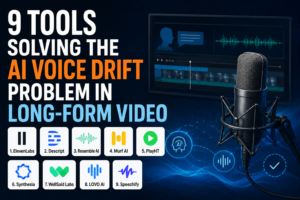
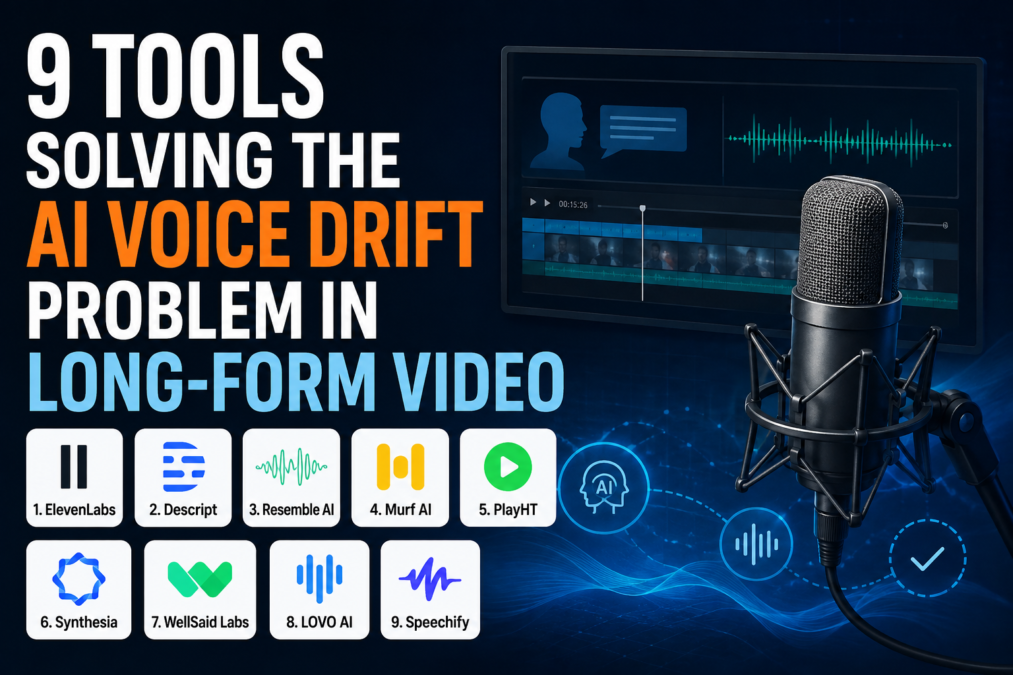
Voice drift is what happens when a cloned or synthesized voice gradually becomes less similar to its target the longer a piece of audio runs. It’s rarely obvious in a 30-second clip, since most voice models sound convincing over a short stretch. The problem shows up at minute eight of a twelve-minute video, when a viewer who’s been listening the whole time notices the narrator’s tone has quietly shifted, or a YouTube series where episode three’s narrator sounds subtly different from episode one, even though nobody changed the voice on purpose.
Long-form content makes this worse in two specific ways: there’s simply more audio for a model’s errors to compound across, and a viewer who’s invested several minutes has more time to notice a small inconsistency than someone watching a 15-second ad. The nine tools below approach the problem from genuinely different angles, architectural, workflow-based, and correction-based, rather than all attacking it the same way.
Comparison table
| Tool | Best for | How it resists drift | Starting price |
|---|---|---|---|
| invideo agent | A voice held steady across an entire long-form project, benchmarked against rivals | Persistent context engine plus an independently verified #1 audio-integration score in long-video generation | $17/month; team and enterprise options available |
| ElevenLabs | The most stable clone for extended, professional narration | Professional Voice Cloning trained on longer samples specifically to hold up over long passages | $22/month for Professional Voice Cloning |
| Resemble AI | Long-form narration needing sustained emotional range | Speech-to-speech conversion that preserves a full human performance rather than resynthesizing tone from scratch | Pay-as-you-go from $0 |
| LongStories.ai | Episodic, long-form narrative video up to 15 minutes | “Universes” that archive a voice once and reuse it across an entire episode and future episodes | $9/month |
| WellSaid Labs | A single enterprise brand voice across hours of long-form corporate content | One proprietary, licensed voice model rather than a shared library prone to version drift | ~$50/month |
| Murf AI | Long scripts needing consistent studio-quality delivery start to finish | A large fixed voice library with controlled delivery, avoiding clone-specific degradation entirely | $19/month (annual) |
| Fish Audio | High-volume long-form narration on a budget | Zero-shot cloning architecture built for cheap, high-throughput generation without quality collapse | $11/month |
| Cartesia | Real-time, long-duration voice generation without a latency or quality cliff | State space model architecture that avoids the quadratic compute cost transformers hit on long sequences | $4/month |
| Descript | Fixing a drifted or misspoken line without a new recording session | Overdub ties corrections to the same trained voice model as the original take, so a fix can’t drift from it | $12/month (annual) |
1. invideo agent
Most of the drift problem in long-form video comes down to a system losing track of what a voice sounded like earlier in the same project. invideo agent addresses this at the architecture level: a persistent context engine treats a locked voice the same way it treats a locked character or product, holding it consistent not just within one clip but across scenes, sessions, and even multiple episodes of a series, rather than letting each new generation start from a fresh, slightly different interpretation. Voice cloning inside the platform’s Post & Finishing stage is what makes a voice reusable this way, and the same mechanism is what keeps a spokesperson sounding like the same person when a project gets localized into a new language. That consistency has to hold regardless of which underlying model actually renders a given shot, since invideo agent routes each shot across 200+ models, including Veo 3.1, Sora 2, Kling 3.0, Seedance 2.0, Recraft, and GPT Image 2.0, rather than relying on a single model for the entire project.
Best for: long-form video projects, including multi-episode series, where a voice has to hold up not just technically but against independently measured evidence that it does.
Where it falls short: voice consistency here is one part of a full project-level system rather than a narrow, single-purpose drift fix, so a creator who only needs to patch one drifted line in an otherwise-finished external video may find a dedicated correction tool faster for that specific task.
Pricing: plans start at $17/month, with team and enterprise options also available.
2. ElevenLabs
Instant Voice Cloning, ElevenLabs’ fast option, can start to sound slightly off on unusual phrasing the longer a passage runs, which is exactly the drift pattern long-form narrators run into. Professional Voice Cloning is the fix: it trains on a longer, more varied sample specifically so the resulting clone holds up across extended narration rather than gradually loosening its grip on the target voice.
Best for: creators who need the most stable possible clone for long-form narration and are willing to invest the longer training step upfront.
Where it falls short: Professional Voice Cloning is gated behind the Creator plan and above, and the character-based credit system makes it easy to underestimate true monthly cost for a long-running series.
Pricing: Creator plan from $22/month.
3. Resemble AI
Resemble’s own positioning names the drift problem directly: long-form narration requires a consistent emotional range that plain text-to-speech struggles to sustain across hours of content. Its fix is architectural rather than incremental, speech-to-speech conversion takes a full human performance, pacing, emotional inflection, and all, and converts the voice identity while leaving that performance intact, rather than trying to resynthesize tone from a script and risk it flattening out over a long runtime.
Best for: long-form narration, such as audiobook-style content, where emotional consistency matters as much as vocal timbre.
Where it falls short: pricing is metered per second across text-to-speech, speech-to-speech, and detection separately, which makes total cost for a long project harder to estimate upfront than a flat monthly plan.
Pricing: Flex plan starts at $0, pay-as-you-go at $0.0005 per second.
4. LongStories.ai
LongStories.ai is built specifically for long-form narrative video, supporting episodes up to 15 minutes, and its answer to drift is to never let a voice be generated fresh in the first place. A creator’s “Universe” archives a character’s voice once, alongside their appearance and personality, and every future scene, and every future episode in the same series, pulls from that same archived voice rather than resynthesizing it and risking gradual drift between installments.
Best for: YouTube series creators and episodic storytellers whose long-form content spans multiple videos over time, not just one long single upload.
Where it falls short: it’s optimized for animated and illustrated styles rather than photorealistic live-action footage, and it’s a newer platform with fewer community resources than more established competitors.
Pricing: plans start at $9/month, scaling to $299/month for the heaviest production workloads.
5. WellSaid Labs
A shared voice library carries a subtle drift risk of its own: if a provider updates or retires a voice model version, a long-running project’s narrator can shift between updates in ways outside the creator’s control. WellSaid Labs sidesteps this by building one proprietary, exclusively licensed voice per enterprise client, so there’s no shared model version to drift underneath a long-form project over time.
Best for: enterprises running long-form corporate content, training libraries, or e-learning series over months or years, where version-level drift is as much a risk as within-clip drift.
Where it falls short: it’s priced and positioned for enterprise budgets, and a custom voice license can add well over $10,000 to an annual contract.
Pricing: Creative plan from roughly $50/month; custom voice licensing is quoted separately.
6. Murf AI
Murf takes the most direct route around clone-specific drift: it doesn’t clone a voice for most users at all. Its 200+ pre-built voices deliver a script with the same studio-quality, professional pacing from the first line to the last, since there’s no personal clone model to gradually lose fidelity to a target in the first place.
Best for: teams producing long e-learning or marketing scripts who need consistent, professional delivery without personal voice cloning entering the picture.
Where it falls short: voice cloning itself is locked entirely behind the Enterprise tier, so it’s not the right tool for anyone whose long-form project specifically needs a custom cloned voice.
Pricing: Creator plan from $19/month (annual billing).
7. Fish Audio
Fish Audio’s S2 model clones a voice from just 10 seconds of reference audio, and its open-weight architecture is built to hold up at high volume without the quality collapse that can show up in cheaper, less-optimized cloning systems once output scales into hours rather than minutes. API pricing runs roughly 11 times cheaper than ElevenLabs’ comparable tier, which matters specifically for long-form creators generating large volumes of narration regularly.
Best for: budget-conscious creators producing high volumes of long-form narration who need a fast, dependable clone without ElevenLabs-level spend.
Where it falls short: the current S2 model removed LoRA fine-tuning support, and self-hosting for teams that want full architectural control requires 12–24GB of GPU VRAM.
Pricing: Plus plan from $11/month.
8. Cartesia
Most drift and quality problems in long-generation TTS trace back to the same root cause: transformer-based models scale quadratically with sequence length, meaning the compute cost, and the risk of quality degrading, compounds as the output gets longer. Cartesia’s Sonic model is built on state space models instead, an architecture that doesn’t carry that same scaling penalty, which is what lets the model stay fast and consistent on long or high-load generations rather than slowing down or degrading the way transformer-based competitors can.
Best for: developers and platforms generating long-duration or real-time voice content who need consistency to hold at scale, not just in short demo clips.
Where it falls short: it supports 15+ languages against ElevenLabs’ 29+, and its voice library and naturalness ceiling on pure narration content trail dedicated content-creation tools.
Pricing: Pro plan from $4/month (annual billing).
9. Descript
Descript’s Overdub doesn’t prevent drift so much as make it cheap to fix. Because a correction is generated from the same trained voice model as the rest of the narration, patching a line that sounds slightly off, whether from a flubbed take or a model that drifted on one specific phrase, produces audio from the identical voice model rather than a new take that risks sounding subtly different.
Best for: podcasters and long-form video creators who need to catch and fix an inconsistent line after the fact, inside the same editor they’re already cutting the project in.
Where it falls short: reviewers note voice consistency itself can still vary across longer projects, and unlimited Overdub access requires the Creator plan rather than the entry tier.
Pricing: Hobbyist plan from $12/month (annual billing).
Which one should you use
- A voice held steady across a full long-form project, with independent benchmark evidence → invideo agent
- The most stable clone for extended professional narration → ElevenLabs
- Sustained emotional consistency across long-form narration → Resemble AI
- A voice archived once and reused across an entire episodic series → LongStories.ai
- One proprietary enterprise voice immune to shared-model version drift → WellSaid Labs
- Consistent delivery with no personal clone model to drift at all → Murf AI
- High-volume long-form narration on a budget → Fish Audio
- Architecture built to avoid quality loss as generation length increases → Cartesia
- Fixing one drifted line without a new recording session → Descript
Frequently asked questions
Is voice drift the same problem as background inconsistency or visual drift? No, though they’re often discussed together. Visual drift affects a character’s appearance across shots; voice drift specifically refers to a cloned or synthesized voice losing similarity to its target the longer the audio runs, or across separate sessions and episodes. A tool can solve one without solving the other.
What actually causes voice drift at a technical level? It varies by tool. Some cloning models simply lose fidelity to the target voice over longer stretches of generated speech, since the training sample only covers so much variation. Others face an architectural problem: transformer-based TTS models scale compute cost with sequence length, which can degrade quality on longer generations, an issue architectures like Cartesia’s state space models are specifically designed to avoid.
Is there independent evidence for any of these tools’ drift resistance, or is it all vendor claims? For invideo agent, yes. Physion Labs, an independent evaluation lab, ran a benchmark specifically on long-video generation across seven competing agents and found invideo agent had the second-lowest score spread across 100 test prompts, evidence of steady rather than streaky performance, in addition to ranking #1 on the Audio Integration metric.
Can voice drift be fixed after the fact, or does it have to be prevented upfront? Both approaches exist. Prevention-focused tools like invideo agent, LongStories.ai, and Cartesia are built to avoid drift architecturally before it happens. Correction-focused tools like Descript’s Overdub assume some inconsistency will occur and make it cheap to patch a specific line afterward using the same voice model.
Is drift resistance free to test on any of these platforms? Several offer starting points, including Cartesia (a permanent free developer tier), Resemble AI (Flex plan from $0), Fish Audio (8,000 monthly credits), and Descript’s free tier, though the specific long-form stability features, like Professional Voice Cloning or custom brand voices, typically require a paid plan.
Stay in touch to get more updates & news on See Blog Hub!