
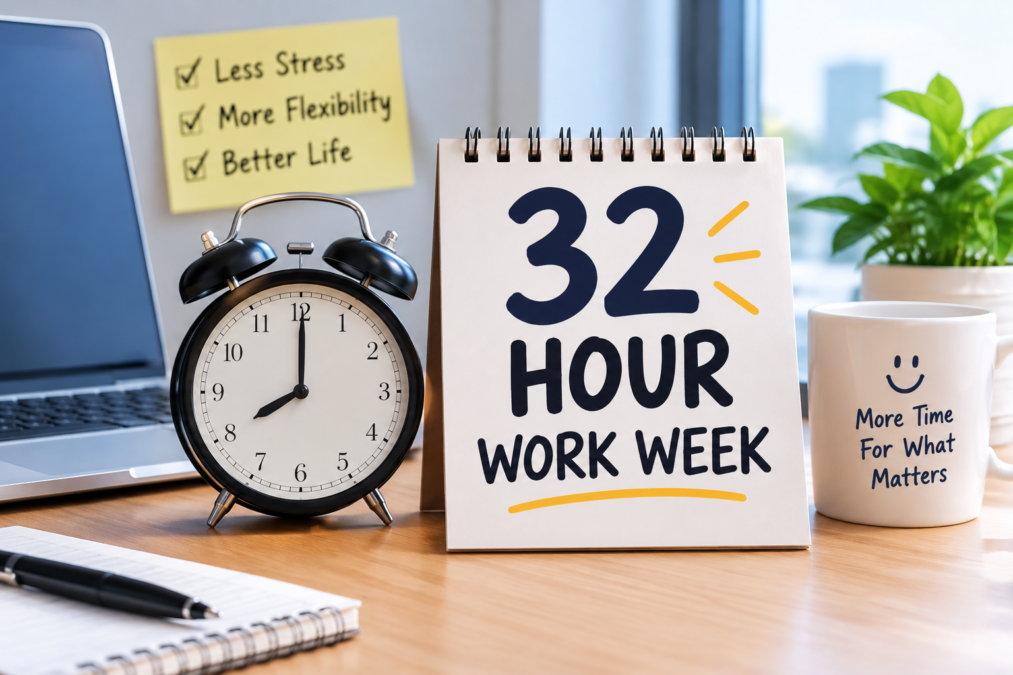
The 32 hour work week is gaining attention as more employees and employers rethink the traditional way of working. For many years, the standard working schedule has been around 40 hours spread across five days. Today, however, businesses are asking whether employees really need to spend that much time at work to achieve good results.
The idea behind a 32 hour work week is fairly simple. Employees work 32 hours during the week instead of 40, while the organization tries to maintain productivity, service quality, and business performance. In some cases, employees may work four eight-hour days. In other workplaces, the 32 hours may be spread across five shorter days.
At first glance, working fewer hours may seem like a major change. Yet, it can also encourage companies to look closely at how time is being used. Long meetings, repeated tasks, unnecessary emails, and inefficient processes can consume hours without creating much value.
A shorter schedule isn’t about telling employees to rush through their work. Instead, it’s about making work more focused, organized, and purposeful. When implemented thoughtfully, the approach may offer benefits for both workers and businesses.
What Is a 32 Hour Work Week?
A 32 hour work week means an employee is scheduled to work 32 hours during a normal week. The exact arrangement depends on the employer and the nature of the job.
One common model is a four-day schedule:
- Monday: 8 hours
- Tuesday: 8 hours
- Wednesday: 8 hours
- Thursday: 8 hours
- Friday: Day off
This arrangement gives employees three days away from work each week.
However, not every organization needs to follow this pattern. Another company might spread the 32 hours across five days, with employees working approximately six and a half hours per day.
Some businesses may also use flexible schedules. Employees could have different days off depending on their role, while the company remains open throughout the week.
The important point is that a shorter working week doesn’t have to follow one fixed formula. Organizations can design a schedule that fits their customers, employees, and daily operations.
Why Are Companies Considering a Shorter Work Week?
The growing interest in a 32 hour work week comes from several changes in modern workplaces.
Technology has made many tasks faster. Cloud software allows teams to work together from different locations. Automation can handle repetitive administrative work. Digital communication has also reduced the need for employees to be physically present for every task.
At the same time, many workers are looking for better work-life balance.
People have responsibilities outside their jobs. They may need time for family, education, exercise, hobbies, household duties, or personal projects. When nearly every weekday is occupied by work, there can be little room left for anything else.
This has led some businesses to experiment with shorter schedules.
The purpose isn’t simply to give employees more free time. A well-designed system can also encourage organizations to become more efficient.
For example, imagine a company where employees spend ten hours every week in meetings. If half of those meetings aren’t necessary, reducing them could create valuable time without reducing meaningful work.
That’s the kind of change that can make a shorter schedule more practical.
How Does a 32 Hour Work Week Work?
There are several ways an organization can introduce a 32 hour work week.
The first option is the four-day model. Employees work eight hours for four days and then have an additional day off.
The second option is a five-day model. Employees work shorter days but continue working Monday through Friday.
A third option is a flexible model. Employees and managers agree on a schedule that meets both personal and business needs.
A fourth possibility is a staggered schedule. Different employees take different days off, allowing the business to remain open for customers.
For example:
| Model | Example | Possible Advantage |
|---|---|---|
| Four-day schedule | 8 hours × 4 days | Three-day weekend |
| Five-day schedule | Around 6.4 hours × 5 days | Daily consistency |
| Flexible schedule | Hours vary by day | Greater employee control |
| Staggered schedule | Different days off | Better business coverage |
| Team-based schedule | Groups rotate days | Maintains staffing |
There isn’t a single perfect solution. The best model depends on the organization’s industry, customer expectations, staffing levels, and type of work.
Benefits for Employees
One of the biggest attractions of a 32 hour work week is the possibility of giving employees more time outside their jobs.
An extra day away from work can make a noticeable difference.
Better Work-Life Balance
Employees may have more time for family, friends, exercise, appointments, and personal responsibilities.
Instead of trying to complete everything after a long working day, people can use their additional free time more effectively.
More Time for Rest
Rest is often underestimated.
Someone who finishes a demanding week may need time to recover mentally and physically. A shorter schedule can provide an additional opportunity to recharge.
And let’s be honest: sometimes doing absolutely nothing for a few hours is exactly what a tired person needs.
Personal Development
Extra free time can also be used for learning.
Employees may take online courses, read books, learn a language, develop technical skills, or work on a personal business.
This can benefit both the individual and, eventually, the workplace.
Higher Job Satisfaction
Employees who feel that their employer respects their time may have a more positive attitude toward their jobs.
A better balance can also make a position more attractive to people who are comparing different employment opportunities.
Benefits for Employers
A 32 hour work week can also offer potential advantages to businesses when the system is carefully planned.
Improved Employee Retention
Replacing experienced employees can be costly. Recruitment takes time, and new workers need training.
If a shorter schedule helps employees remain satisfied, businesses may be able to keep skilled workers for longer.
Better Recruitment
Modern workers often consider more than salary when evaluating a job.
Flexible schedules, remote work, paid leave, and shorter working weeks can all influence a person’s decision.
A company offering a thoughtful shorter-week policy may stand out in a competitive employment market.
Potential Productivity Improvements
Working longer doesn’t automatically mean working better.
An employee who is tired, distracted, or overwhelmed may struggle to remain productive for a full day.
A shorter schedule can encourage businesses to identify inefficient processes and focus employees on high-value tasks.
Lower Workplace Burnout
Burnout can affect motivation, concentration, creativity, and job satisfaction.
Although reducing working hours isn’t a complete solution, additional recovery time may help create a healthier working routine.
Does Working Fewer Hours Reduce Productivity?
This is probably the biggest question surrounding a 32 hour work week.
The answer isn’t simply yes or no.
Productivity depends on the type of work, how employees are managed, how goals are measured, and how efficiently tasks are organized.
If a company simply removes eight hours from the schedule while expecting employees to complete exactly the same workload without changing anything else, problems could appear.
Employees may feel pressured to work faster.
That isn’t the ideal approach.
Instead, businesses should examine their current workflow before reducing hours.
They can ask:
- Which meetings are unnecessary?
- Which tasks can be automated?
- Which reports can be simplified?
- Are employees handling duplicate work?
- Are priorities clearly communicated?
- Can approval processes be shortened?
- Are employees spending too much time on administrative work?
The answers can reveal opportunities to save time.
The real objective should be smarter work, not simply faster work.
Four-Day Week vs. 32 Hours
People often use the terms “four-day work week” and 32 hour work week as if they mean exactly the same thing. They don’t.
A four-day work week only tells us that someone works four days.
For example, an employee could work:
- Four days × 8 hours = 32 hours
- Four days × 9 hours = 36 hours
- Four days × 10 hours = 40 hours
Therefore, a four-day schedule isn’t automatically a 32-hour schedule.
Likewise, someone can work 32 hours across five days.
This distinction is important when comparing workplace policies.
A company advertising a four-day week may still expect 40 total hours. Another company may offer a genuine reduction to 32 hours.
Employees should always check the actual number of scheduled working hours rather than relying only on the name of the policy.
Challenges Businesses Need to Consider
Although a 32 hour work week sounds appealing, it can create practical challenges.
Customer Service
Some businesses need to remain available throughout the week.
A company can’t simply stop serving customers every Friday if clients depend on five-day coverage.
A staggered schedule may solve this problem.
Workload
Employees shouldn’t be expected to complete an unrealistic amount of work in less time.
Management needs to review responsibilities and deadlines before changing schedules.
Communication
When employees have different days off, teams need clear communication systems.
Everyone should know:
- Who is available?
- Who handles urgent requests?
- Who covers customer questions?
- When should messages be answered?
- Which tasks can wait?
Without clear rules, a shorter week can become confusing.
Industry Requirements
Not every job can be managed in the same way.
A software company may have more flexibility than a hospital, manufacturing plant, restaurant, or retail store.
That doesn’t mean shorter schedules are impossible in those industries. It simply means the design may need to be different.
How to Introduce a Shorter Schedule
Companies interested in a 32 hour work week don’t necessarily need to make the change permanent immediately.
A trial period can be a sensible first step.
For example, an organization could test the schedule for several months and compare its performance with the previous system.
During the trial, management could measure:
- Employee satisfaction
- Productivity
- Customer satisfaction
- Revenue
- Project completion
- Absence rates
- Overtime
- Staff turnover
- Response times
These measurements can help leaders make a decision based on evidence rather than assumptions.
Start Small
A company could begin with one department.
If the results are positive, the model can gradually expand.
Establish Clear Rules
Employees need to understand exactly how the new schedule works.
Managers should explain working hours, availability, deadlines, meetings, holidays, and emergency procedures.
Improve Processes First
Reducing unnecessary tasks before shortening the schedule can make the transition much easier.
Gather Employee Feedback
Employees experience workplace processes every day. Their feedback can reveal problems that management may not notice.
How Employees Can Make the System Work
A successful 32 hour work week isn’t only the employer’s responsibility.
Employees also need to use their working hours wisely.
That doesn’t mean constantly rushing.
Instead, workers can improve their organization.
Useful habits include:
- Planning the day’s most important tasks.
- Turning off unnecessary notifications.
- Preparing before meetings.
- Avoiding unnecessary multitasking.
- Communicating deadlines clearly.
- Keeping project information organized.
- Completing high-priority work first.
- Taking proper breaks.
Good time management becomes especially important when working hours are reduced.
The goal is to make each hour meaningful rather than trying to fill every minute with activity.
A Practical Example
Consider a small marketing agency with twelve employees.
The company currently operates from Monday to Friday, with employees working eight hours per day.
Management notices that staff members spend a significant amount of time in internal meetings and repetitive administrative tasks.
The company decides to test a 32 hour work week.
Employees work eight hours from Monday to Thursday and have Friday off.
Before the trial begins, the company makes several changes:
- Meetings are shortened.
- Weekly meetings are replaced with written updates where possible.
- Project responsibilities become clearer.
- Repetitive reports are automated.
- Employees receive clearer weekly priorities.
The company then measures its results.
If projects remain on schedule and customers continue receiving good service, the trial may be considered successful.
If problems appear, management can adjust the system.
This example demonstrates an important lesson: changing the schedule alone isn’t enough. The entire workflow needs to support the change.
Is a 32 Hour Work Week Right for Everyone?
A 32 hour work week won’t be the best choice for every employee or company.
Some employees may prefer a traditional schedule because they want to maximize their working hours or income.
Others may value additional personal time more highly.
The same is true for businesses.
A small company with limited staff may find scheduling difficult. A large organization may have enough employees to rotate days off easily.
The nature of the job matters, too.
Jobs based on measurable projects may be easier to restructure than positions requiring continuous physical presence.
However, even businesses with fixed operating hours can explore creative scheduling.
The key is to match the working model to actual business needs.
How to Measure Whether It Is Working
A shorter schedule shouldn’t be judged only by employee happiness.
That’s important, but businesses also need to consider performance.
Managers can track several indicators.
| Measurement | What It Shows |
|---|---|
| Revenue | Business performance |
| Customer satisfaction | Quality of service |
| Project completion | Team efficiency |
| Employee turnover | Staff retention |
| Absence | Workplace well-being |
| Overtime | Whether workloads are realistic |
| Employee feedback | Worker experience |
| Quality levels | Standard of completed work |
If employee satisfaction rises but customer service falls sharply, the company may need to change its model.
Likewise, if productivity remains strong and employees report better balance, the results may support continuing the schedule.
The best decisions come from looking at several measures together.
Common Myths About Shorter Working Weeks
There are several misunderstandings about the 32 hour work week.
Myth: Fewer Hours Always Mean Less Work
Not necessarily.
Better processes can remove wasted time and allow teams to focus on important responsibilities.
Myth: Everyone Gets Every Friday Off
Not always.
Companies can use rotating schedules to keep operations running throughout the week.
Myth: Employees Must Work Extremely Fast
That’s not the goal.
A healthy system should reduce unnecessary work rather than create constant pressure.
Myth: A Shorter Week Solves Every Workplace Problem
It doesn’t.
Poor leadership, unrealistic workloads, weak communication, and an unhealthy company culture still need attention.
Myth: Only Technology Companies Can Use It
Technology companies may have more flexibility, but other industries can explore different scheduling models too.
The Role of Technology
Technology can make a 32 hour work week easier to manage, especially when it removes repetitive work.
For example, businesses can use software to automate:
- Data entry
- Appointment reminders
- Basic reports
- Invoice processing
- Email sorting
- Task assignments
- Internal notifications
However, technology should be used carefully.
Adding too many apps can actually make work more complicated.
The best technology is often the kind employees barely notice because it quietly removes unnecessary effort.
The Future of Shorter Working Hours
The discussion around shorter working schedules is likely to continue as workplaces evolve.
Remote work, automation, artificial intelligence, flexible employment, and changing employee expectations are all influencing how organizations think about time.
The traditional idea that productivity must be measured by hours spent at a desk is being questioned in many workplaces.
That doesn’t mean working hours no longer matter. Some jobs depend heavily on time and availability.
But for many roles, the quality of the work may be more important than simply counting hours.
Future workplaces may therefore use a mixture of approaches, including shorter weeks, flexible schedules, remote work, compressed schedules, and job sharing.
Rather than one universal model, businesses may choose systems that fit their specific needs.
Frequently Asked Questions
What exactly is a 32 hour work week?
A 32 hour work week is a schedule in which an employee works 32 hours during a normal week. Those hours can be divided across four or five working days.
Is a 32-hour schedule the same as a four-day week?
No. A four-day week can contain more than 32 hours. A 32-hour schedule specifically means 32 total working hours.
Can employees receive the same salary?
That depends on the employer’s policy, employment agreement, and applicable labor laws. There is no universal rule that applies to every workplace.
Can small businesses use this model?
Yes, but they need to consider staffing, customer coverage, workload, and financial requirements carefully.
Does a shorter week automatically increase productivity?
No. Productivity depends on how work is organized. A shorter schedule can work well when companies remove inefficient processes and establish clear priorities.
Can employees work five days under this model?
Yes. A business can distribute 32 hours across five shorter working days instead of four full days.
How should companies test the idea?
A temporary pilot can be useful. Businesses can measure productivity, customer satisfaction, employee feedback, overtime, and other important indicators before deciding whether to continue.
Final Thoughts
The 32 hour work week represents a broader conversation about how modern workplaces should use time.
For employees, it may offer more opportunities for rest, family, learning, hobbies, and personal responsibilities. For employers, it may encourage better processes, stronger retention, improved recruitment, and a more focused workplace.
Still, a shorter schedule isn’t a magic solution.
It needs careful planning.
Companies must consider customer needs, workloads, staffing, communication, compensation, and industry requirements. Employees also need to manage their time responsibly and focus on meaningful work.
The most promising approach is to treat a shorter schedule as an experiment in better work rather than simply fewer hours.
When organizations remove unnecessary meetings, automate repetitive tasks, clarify priorities, and measure real outcomes, they may discover that productivity doesn’t always depend on spending more time at work.
Ultimately, the 32 hour work week is less about watching the clock and more about asking a useful question: How can people and businesses achieve strong results while creating a healthier and more sustainable way to work?
For some organizations, that answer may be a shorter week. For others, it may be a flexible schedule or a different approach entirely. Either way, the conversation is valuable because the future of work should be designed around both human needs and meaningful business results.
Stay in touch to get more updates & news on See Blog Hub!